Vibe Forger
AI-powered platform for moving micro-SaaS ideas through research, strategy, copy, build, and launch.
Context
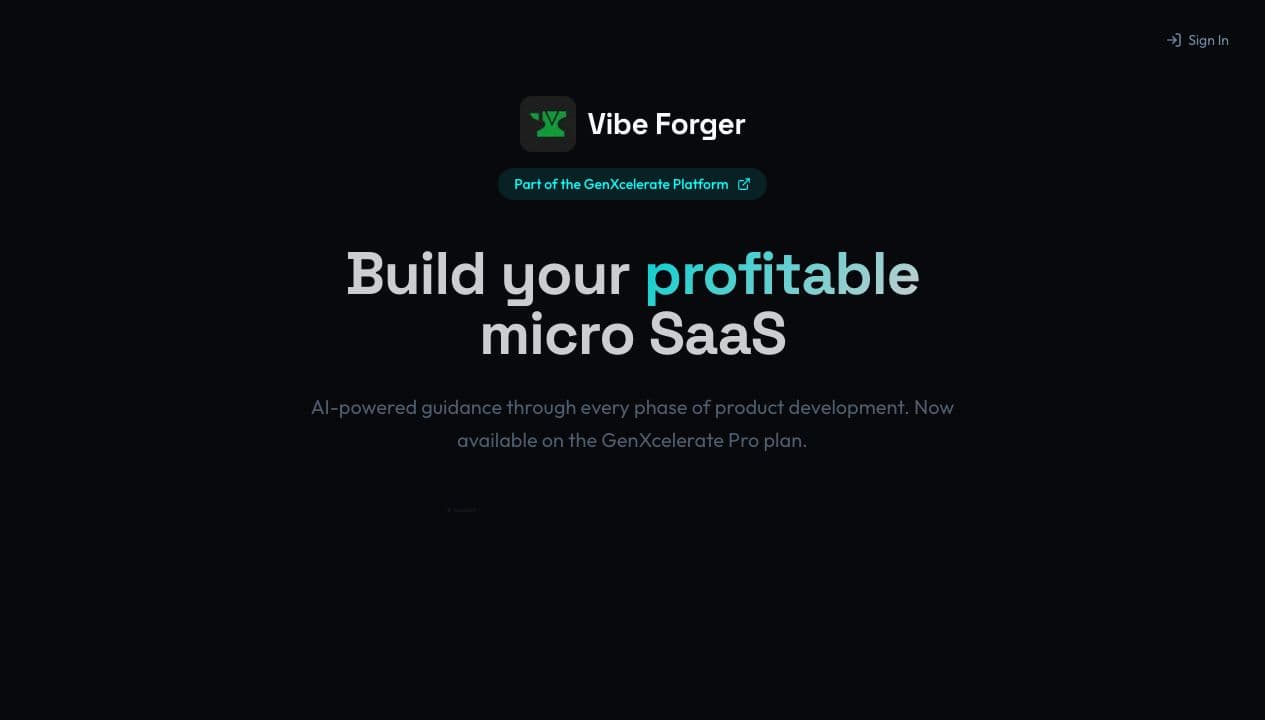
Vibe Forger is an AI-powered platform for solo founders and indie hackers building micro-SaaS products. It turns a messy product idea into a guided five-phase workflow: Research, Strategy, Copy, Build, and Market.
The premise is simple: most people do not need more blank-page AI chat. They need a structured operating system that carries context forward.
Problem
Building a SaaS product involves hundreds of decisions: what problem to solve, who will pay, how to position it, what to build first, what to charge, and how to launch.
Without structure, AI can make that chaos faster instead of better.
What Shipped
- Five phase pages with specialized AI guidance for research, strategy, copy, build, and market.
- A phase context bridge that injects prior outputs into later AI interactions.
- Project creation, onboarding, phase tracking, and guided milestone completion.
- Save-as-deliverable flow for turning useful AI responses into reusable project assets.
- Phase checklists, briefing cards, editable outputs, markdown export, and first-project onboarding.
- Supabase magic-link auth, Postgres/RLS tables, beta access gating, admin panel, and persistent AI rate limiting.
Architecture
The app is built on Next.js, TypeScript, Tailwind, shadcn/ui, Supabase, and the Vercel AI SDK with Anthropic Claude. The core data model centers on projects, phase outputs, chat messages, and user profiles.
The key architectural decision is that outputs become structured project memory. The system does not rely on one long chat thread to remember the work.
Key Decisions
- Make phases explicit. Research, Strategy, Copy, Build, and Market give users a map instead of another blank chat box.
- Save outputs intentionally. AI responses are not automatically promoted into project artifacts. Users choose which responses become deliverables, which keeps the workspace cleaner.
- Carry context forward. Prior phase outputs are injected into later phases so the product behaves like an operating system, not five isolated prompts.
- Use beta access as product control. The waitlist/admin model allows a controlled rollout while the workflow and prompts mature.
AI / Workflow Layer
Each phase has a distinct assistant role, prompt library, checklist, and expected deliverable shape. Earlier work feeds later work, so strategy can inform copy, copy can inform build, and build can inform launch planning.
This is OperatorLab thinking turned into a product: the workflow is not supporting material; it is the product.
Sample Artifact
The useful output is a chain of artifacts rather than one generated document:
- A research brief that identifies the customer and pain.
- A strategy brief that chooses positioning, pricing, and scope.
- A copy package that turns the strategy into market-facing language.
- A build plan with technical spec, schema, and implementation prompts.
- A market plan with launch channels and content prompts.
The product's job is to make those artifacts accumulate coherently.
Constraints
- AI responses need to be useful enough to save, but not auto-saved as clutter.
- Users need guardrails without feeling trapped in a rigid wizard.
- The app needs controlled beta access while still communicating value publicly.
- Rate limits need to protect model usage without breaking the experience.
Tradeoffs
- A phased workflow reduces chaos, but it has to leave room for founders who already know where they want to start.
- Saved deliverables create durable memory, but they require better curation than a raw chat transcript.
- A specialized prompt library produces better guidance, but it also creates an ongoing maintenance surface as the product methodology improves.
What I Would Improve Next
- Add richer export paths for Notion, Google Docs, and investor/customer-ready briefs.
- Add analytics that show where founders stall in the workflow.
- Add collaboration so a founder can invite a designer, engineer, or advisor into a project.
What It Proves
Vibe Forger shows the ability to productize an AI-native workflow: not just a demo of AI output, but a system for carrying decisions from fuzzy idea to executable plan.