Partner Enablement MCP
Enterprise MCP security and partner enablement demo for Atlassian Rovo workflows.
Context
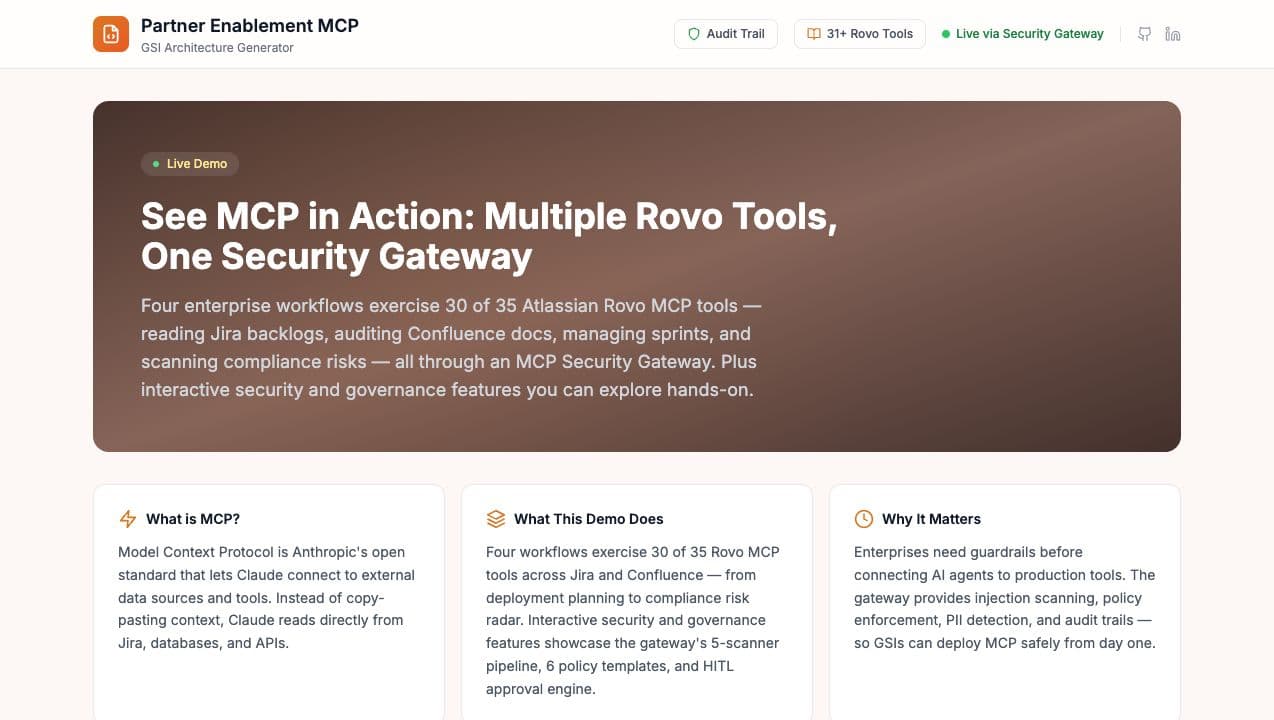
Partner Enablement MCP is an enterprise demo for showing how Global System Integrators can operationalize AI agents with Model Context Protocol, Atlassian Rovo tools, and a security gateway that sits between the agent and production systems.
The demo is built for a buyer who is interested in MCP, but not yet comfortable letting agents touch Jira, Confluence, or implementation workflows without governance.
Problem
Enterprise teams do not just need agent access to tools. They need policy, audit, approval, PII handling, prompt-injection scanning, and a way to explain the whole thing to security and platform teams.
Without that layer, MCP feels exciting in a prototype and frightening in production.
What Shipped
- An MCP server connecting Claude to Jira workflows and partner enablement knowledge.
- A web demo that exercises Atlassian Rovo, Jira, and Confluence workflows.
- A gateway with policy enforcement, injection scanning, PII detection, audit logging, tool drift checks, human approval, and webhook alerts.
- A governance dashboard for policies, approvals, audit, alerts, server inventory, API keys, and billing.
- A mock fallback path so the demo still teaches the workflow when live dependencies are unavailable.
Architecture
The system is split into an MCP server, a Next.js web demo, an Express-based gateway, and a governance dashboard. Tool calls flow from the agent surface through the gateway before reaching the Atlassian/Rovo layer.
That gateway is the important product decision. It makes the security and governance layer visible rather than treating it as a footnote.
Key Decisions
- Make the gateway visible. The demo does not hide governance behind a generic "secure by default" claim. It shows the audit trail, policy checks, tool risk, and approval points as part of the product surface.
- Separate demo reliability from live dependency health. The mock fallback lets the field narrative continue even if an Atlassian tenant, OAuth flow, or gateway process is unavailable during a live walkthrough.
- Treat write operations differently from reads. Jira comments, issue edits, transitions, and Confluence page creation are framed as higher-risk actions that can require policy controls or human approval.
- Use Atlassian as a concrete enterprise anchor. Jira and Confluence make the agent workflow legible to buyers because the tools map to real delivery processes, not abstract demo data.
AI / Workflow Layer
The AI layer is not a generic chatbot. It is a tool-using workflow where the interesting question is: what should the agent be allowed to read, write, summarize, and modify?
That makes the demo useful for field conversations about MCP adoption, not just MCP mechanics.
Sample Artifact
A strong output from this system is not just "Claude read Jira." A strong output is a customer-ready explanation of an agent action:
The agent searched Jira and Confluence for delivery risk signals, mapped the relevant compliance framework, generated an implementation plan, and passed each tool call through policy, PII, injection, and audit checks before surfacing the recommendation.
That sentence is the buyer conversation. The system exists to make it true.
Constraints
- Tool calls need to be explainable to non-developer stakeholders.
- Security policy has to be visible enough for buyers to trust the demo.
- Live integrations need a fallback path.
- Write operations need clear approval and audit semantics.
Tradeoffs
- The gateway adds conceptual overhead, but that overhead is the point for enterprise buyers.
- Mock fallbacks reduce demo risk, but they have to stay realistic enough not to feel like a toy path.
- A broad Rovo tool surface proves ambition, while policy templates keep the experience from becoming an uncontrolled agent free-for-all.
What I Would Improve Next
- Add a downloadable one-page security architecture brief for buyer follow-up.
- Add scenario-specific walkthrough recordings for healthcare and financial services.
- Add a short "before gateway / after gateway" comparison for non-technical stakeholders.
What It Proves
This system shows enterprise AI enablement at the layer where adoption usually gets blocked: security, governance, buyer trust, and field-ready explanation.