GSI AI / Muno Labs Proposal App
Healthcare reference architecture generator for partner-led enterprise AI deployments.
Context
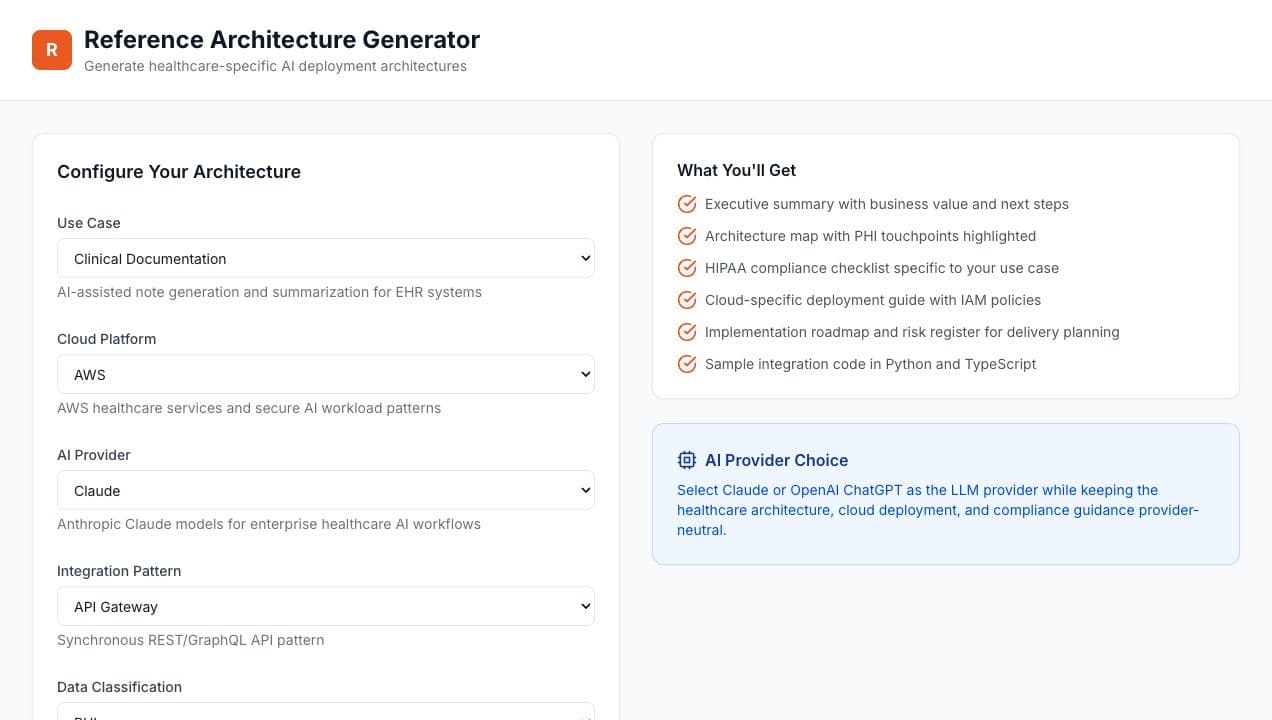
GSI AI is a reference architecture generator for Global System Integrator teams working on healthcare AI deployments. It helps partner teams create proposal-ready architecture collateral without waiting for a senior architect to recreate the same regulated patterns from scratch.
The public app is access-gated, so the OperatorLab case study is designed to stand on its own.
Problem
Healthcare AI architecture is repetitive and high-stakes at the same time. Every engagement needs HIPAA guidance, PHI handling, BAA awareness, cloud-specific infrastructure notes, provider-specific implementation details, risk framing, and a credible rollout plan.
That work is too important to fully improvise and too common to rebuild from zero.
What Shipped
- Inputs for healthcare use case, deployment cloud, AI provider, integration pattern, data classification, and scale tier.
- Provider-agnostic generation that supports Claude and OpenAI ChatGPT.
- Proposal-ready outputs: Mermaid architecture diagram, executive summary, component inventory, data flows, HIPAA checklist, deployment guide, roadmap, risk register, and sample code.
- Streaming sections generated in parallel for better perceived latency.
- In-memory caching for repeated demo configurations.
Architecture
The app uses a React/Vite frontend and a FastAPI backend with Pydantic validation. Generation requests route to the selected provider while preserving provider-neutral product language where the provider choice does not matter.
The architecture deliberately separates deployment cloud from LLM provider, because real enterprise buyers often make those decisions independently.
Key Decisions
- Separate cloud choice from model choice. Healthcare customers may standardize on AWS or Google Cloud separately from Claude or OpenAI, so the workflow keeps those decisions independent.
- Generate sections in parallel. Architecture, compliance, deployment, roadmap, and risk content can stream as separate sections instead of waiting for one monolithic response.
- Make compliance explicit. PHI touchpoints, BAA considerations, logging guidance, and human-review notes are first-class outputs rather than generic disclaimers.
- Use code-based diagrams. Mermaid output makes generated architecture visible, editable, and portable into partner collateral.
AI / Workflow Layer
The workflow codifies the shape of a partner architecture engagement: gather customer context, select deployment constraints, generate a structured reference architecture, and produce collateral a pre-sales or solution architecture team can refine.
The AI output is not treated as final authority. It is treated as the first 80 percent of a regulated architecture package.
Sample Artifact
A strong generated package includes:
- Executive summary for the buyer.
- Architecture diagram with PHI touchpoints.
- Component inventory and data-flow notes.
- HIPAA checklist and BAA considerations.
- Deployment plan with IAM, networking, monitoring, and audit controls.
- Risk register with mitigation owners.
- Provider-specific Python and TypeScript integration examples.
Constraints
- The product must not imply legal, privacy, or security approval.
- Generated content must mark PHI touchpoints and avoid raw PHI in logs.
- Provider-specific guidance must update when the selected provider changes.
- Output needs to be useful in a partner conversation, not just technically plausible.
Tradeoffs
- A healthcare focus narrows the market, but it makes the demo more credible because the compliance burden is concrete.
- Provider-agnostic positioning avoids vendor lock-in language, but it requires more careful prompt and UI design.
- Generated architecture accelerates the first pass, while human review remains mandatory for regulated production decisions.
What I Would Improve Next
- Add downloadable architecture packets for common healthcare use cases.
- Add a comparison view that shows how the same use case changes across AWS/GCP and Claude/OpenAI.
- Add review checkpoints for security, privacy, and clinical stakeholders.
What It Proves
This system shows how to turn senior architecture judgment into a repeatable partner enablement workflow for regulated enterprise AI.